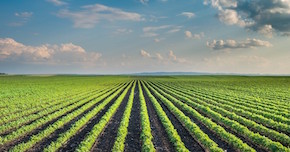
Sally lay down in the field after a long day of picking and pruning. The sun was setting and the crows finally started to head of home, cackling all the way. She looked forward to the peace and quiet, figuring she’d have about twenty minutes of silent reverie as the sun set and the crows flew off. Many of them, in fact, had already headed back to the city for the winter, as the crops were getting hauled in.
Such a magical time, it helped her to recover, spiritually, from a long day of hard work. Physical recovery would have to wait until she had her bath and laid down in bed to recuperate, a bit of peace and quiet before falling asleep and beginning anew once again.
This was back during an epoch when farms were individual homes, lands worked by a family and maybe a couple of other fellas from time to time. Back before things went in a different direction, back before corn and soybeans.
The placid river looks appealing enough, flowing nice and easy through the hilly knobs on either shore, curtailing around the bend westward, perhaps. But around that turn, just out of sight, there is a situation. The water enters into a zone of enhanced reality, a transformed ecosphere where Sally would not be comfortable laying in the grass. The grass, here, is not really grass, after all. One won’t sense that smell of moist old logs, the murmurings of crinkling leaves scattered by the breeze.
The crows are not here in this zone, having successfully resisted the chip implants that were guaranteed to enhance the essence of their lives, to make their dark feathers even blacker and sleeker, to make their cackles even more sonically rhythmic and audacious, their sense of smell enhanced with signal extenders to more easily track dead squirrels, fast food containers, and other food sources.
The crows consulted and decided against the offer and flew off to the city and other more remote areas where they could maintain their traditional crowiness. Sally watched them as they reached their decision after counting the votes. The crops and the fruit trees, they went down a different road, having been drawn in to the appealing offer of a fungus-free future (FFF). Their leaves were tagged with RF tags, each one a separate identifier with Bluetooth GPS geo-location antenna-free maintenance. The stalks and trunks injected with a special blend of FFF formula (FFFF), and the roots tied in to the inter-zone sub-strata micro-fiber monitoring system. Moisture and soil quality are automatically adjusted, sun and wind exposure engineered for precise precision outputs.
Sally had received glossy mailers attached to her doorknob every morning, soliciting her participation in the fungus-free future formula fund (FFFFF). The company already had enough money to pay for the entire operation of course, but their consultants had argued that with monetary buy-in from the community, the people would “own it” themselves, and thus feel more beholden to the company and less-resistant to the imposition of the enhancements. The fund was a big success with its solicitations, and even provided the money for a lavish company Christmas party every year. Sally went to one once, but left early.
But the income generated by the FFFFF was a drop in the bucket compared to the revenue generated from the corn and soybean seed growth expansion. Every field that was already cleared was quickly eradicated of what had been growing there before, and replaced with the perfectly-matched corn seeds for that particular soil. Bordering lots were treated the same and planted through drone-guided precision with the appropriate soybean seed synchronization (SSS).
And while those fields were being planted, other lands were cleared; timber was uprooted, boulders cleared, slopes flattened, applications applied and ultra-sonic scans taken and studied for ultimate planting optimization. Each plant pre-installed with the RF tracker chip, communicating moisture, sun, soil and fungus information. Each farmer waiting for the computer to process the data and to export it to his machinery, as long as he was paid up on his soybean seed synchronization subscription (SSSS).
The fruit trees were putting out fruit like nobody’s business, and it was all great looking fruit, perfectly, round, shiny and very firm, built to last for weeks after being picked, bug-resistant, fungus-resistant, indestructible shiny orbs filling every growth node on every chemically-controlled branch. Some trees were proud. They felt strong and more productive than ever. Other, more sensitive deciduous beings, felt somehow sad, depressed, angry, self-alienated. Their fruit all looked the same, as it was, of course, fungus-free futures formula fertilized fruit (FFFFFF), and they missed the variety, the differences and variations. They even went so far as to miss the worms and bugs. They even missed the pesky crows who had abused them all these years.
But what could they do? There was no going back, really, unless they waited for many generations yet to come. But hidden in Sally’s garden were a few old gnarly stalks, wild plants that grew where they felt most at home, where they fit in best with the others. The old tall oaks and cottonwoods letting enough light in to reach the little saplings down below. The wild ginger pungent in the morning sun. Little field mice streaking through the underbrush in search of tasty treats.

 THE MOSSY BOG